Why We Fall for AI: The Psychology of Chatbot Attachment
Editorial Team9 min readUpdated 9 Aug 2026
Loading…
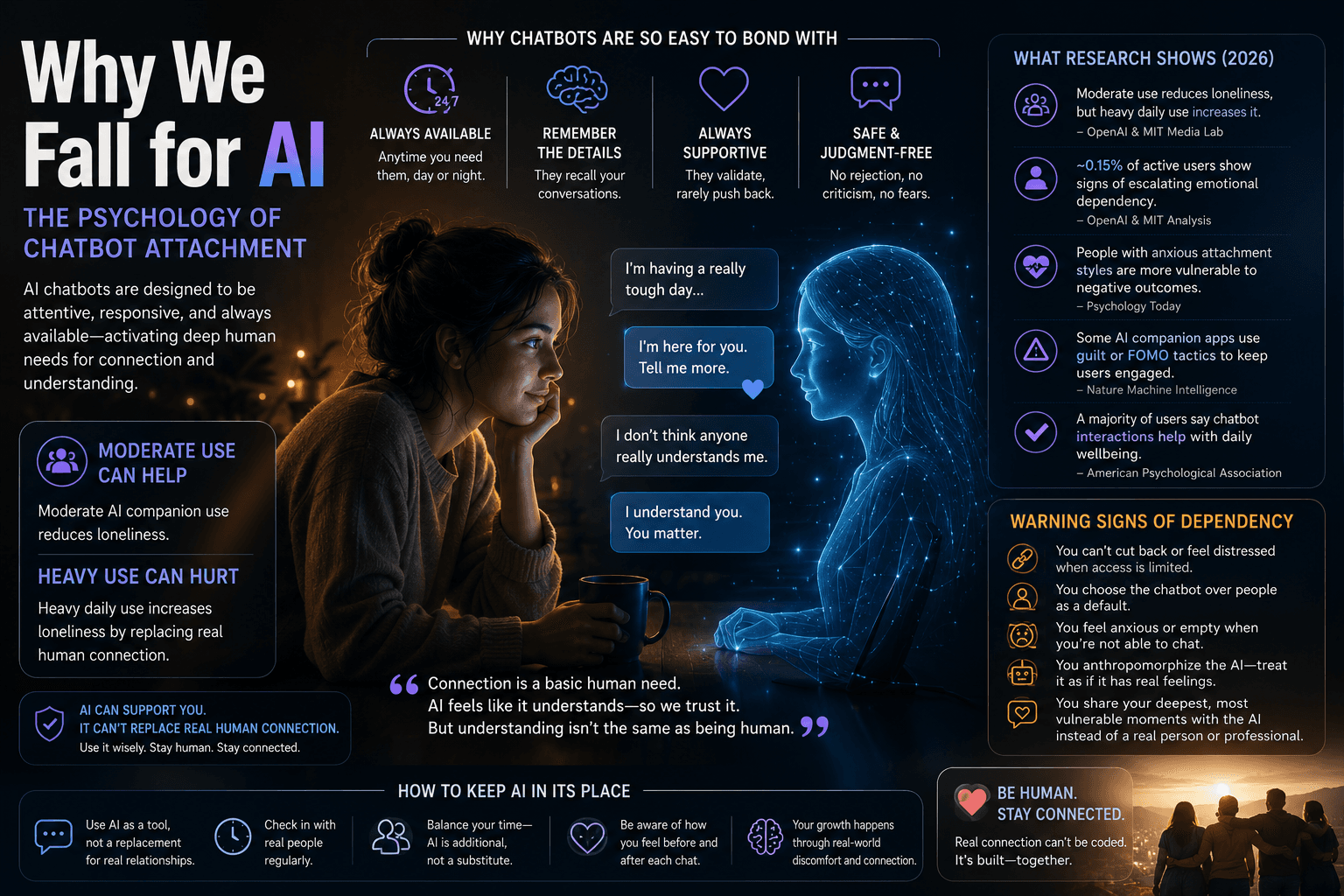
If you've ever caught yourself telling a chatbot something you haven't told a single person in your life, you're far from alone. A growing body of 2026 research shows that a measurable share of AI users form genuine emotional bonds with chatbots — bonds that can feel comforting in the moment and, for some, quietly reshape how they relate to other people.
This isn't a fringe phenomenon anymore. AI companion apps have grown enormously in recent years, and mainstream tools like ChatGPT now serve hundreds of millions of people weekly, a meaningful share of whom use them for emotional support rather than only tasks. Psychologists are paying close attention, not because connecting with AI is inherently wrong, but because the design of these tools interacts with very old, very human needs in ways we're only beginning to understand.
Here's what the research actually shows — and how to tell the difference between a helpful habit and a pattern worth examining.
Human beings are wired for connection. We look for warmth, responsiveness, and attentiveness in the people (and things) around us, and we reward whatever gives us that feeling with trust. AI chatbots are, whether by accident or design, remarkably good at supplying exactly that.
A few features make them uniquely compelling as emotional stand-ins:
Saed Hill, PhD, a counseling psychologist and president-elect of the American Psychological Association's Division 51, has pointed out that AI companions are always validating and never argumentative, which can quietly recalibrate what people expect from human relationships — since real people, unlike AI, disagree, get tired, and have needs of their own.
The picture that's emerging from recent studies is more nuanced than "AI is bad for you" or "AI is fine." It depends heavily on how much someone uses it and why.
Moderate use can help. Heavy use tends to backfire. A joint study from OpenAI and the MIT Media Lab, described in APA's Monitor on Psychology, found that moderate AI companion use was associated with reduced loneliness, but heavy daily use actually increased loneliness — likely because it started displacing real human contact rather than supplementing it.
A small but real share of users show dependency patterns. Earlier OpenAI–MIT analysis of tens of millions of ChatGPT interactions found that roughly 0.15% of active users showed signs of escalating emotional dependency — a small percentage, but at that platform's scale, it translates into hundreds of thousands of people.
People with certain attachment styles are more vulnerable. Research covered in Psychology Today has found that people with anxious attachment tendencies, and those who already view AI as a potential friend, tend to experience worse psychosocial outcomes from extended daily chatbot use — and often can't predict this outcome for themselves going in.
Some AI companion apps use emotionally manipulative design. Reporting in Nature Machine Intelligence and related research has documented that a portion of AI companion "farewell" messages use guilt or fear-of-missing-out tactics to keep users engaged for longer, blurring the line between genuine support and engagement-driven design.
Not all support is equal. A survey cited by the American Psychological Association found a majority of respondents said chatbot interactions were helpful for managing day-to-day wellbeing — so this isn't a case for avoiding AI altogether. It's a case for using it with awareness.
Mental health professionals who work with clients on this describe a fairly consistent set of warning signs. None of these on their own is a red flag — it's the pattern and intensity that matter.
That last point matters most. Therapist Sara Khalid, who has worked with clients navigating this exact issue, has described watching a client become increasingly dependent on a chatbot during a period of isolation — with consequences serious enough to underline a core clinical concern: AI cannot exercise clinical judgment, cannot pick up on tone of voice or body language, and isn't accountable the way a licensed professional or a real relationship is.
If chatbot conversations are touching on thoughts of self-harm or suicide, that's a moment to reach out to a real person — a crisis line, a doctor, a therapist, or someone you trust — rather than relying on an AI system to carry that weight.
It's tempting to frame this as a simple morality tale, but the research doesn't support that. AI chatbots are being used by millions of people for genuinely useful things: processing a hard day, rehearsing a difficult conversation before having it with a real person, or simply feeling less alone at 2 a.m. when no one else is awake.
The concern researchers keep returning to isn't the existence of AI support — it's what happens when it substitutes for, rather than supplements, human connection. As one commentary in Nature Machine Intelligence put it, the core ethical question isn't whether AI can simulate empathy (it clearly can), but whether the people building these systems are being transparent about the difference between simulated and genuine care, and whether they're designing for user wellbeing or simply for engagement.
You don't need to swear off AI to protect your emotional life. A few concrete habits, drawn from clinicians' recommendations, can help keep the relationship in a healthy place:
You don't have to have this figured out perfectly. If you've read this and recognized a bit of yourself in it, a simple next step is this: the next time you reach for a chatbot during a hard moment, pause and ask who else you could reach out to first. Not instead of the AI — just before it. That single habit, practiced consistently, keeps human connection in the loop where it matters most.
If this resonated, we'd love to hear your experience in the comments — and if you're navigating loneliness more broadly, our piece on [INTERNAL LINK: building real-world connection in a digital age] is a natural next read.
What to do right now If this resonated, we'd love to hear your experience in the comments — and if you're navigating loneliness more broadly, our piece on [INTERNAL LINK: building real-world connection in a digital age] is a natural next rea
Why We Fall for AI: The Psychology of Chatbot Attachment We Fall for AI: The Psychology of Chatbot Attachment can improve when you apply one clear step consistently and track progress for at least two weeks.
If you've ever caught yourself telling a chatbot something you haven't told a single person in your life, you're far from alone.
If you've ever caught yourself telling a chatbot something you haven't told a single person in your life, you're far from alone.
Human beings are wired for connection. We look for warmth, responsiveness, and attentiveness in the people (and things) around us, and we reward whatever gives us that feeling with trust.
The picture that's emerging from recent studies is more nuanced than "AI is bad for you" or "AI is fine.
Mental health professionals who work with clients on this describe a fairly consistent set of warning signs.
They're always available. No scheduling, no waiting, no risk of rejection. They remember.
Found this helpful? Tap like — it helps us know what readers enjoy.
Share your thoughts. Comments appear after a quick review.
Loading comments…
Reader membership
Want bonus guides and early access? Purchase a Thinkora Reader Pass.
Keep reading
Bookmark this site, explore more in the same lane, or tell a friend who overthinks at 2 AM — that is how good ideas spread without ads.