Why Do People Ghost Someone They Once Liked?
Editorial Team7 min readUpdated 31 Jul 2026
Loading…
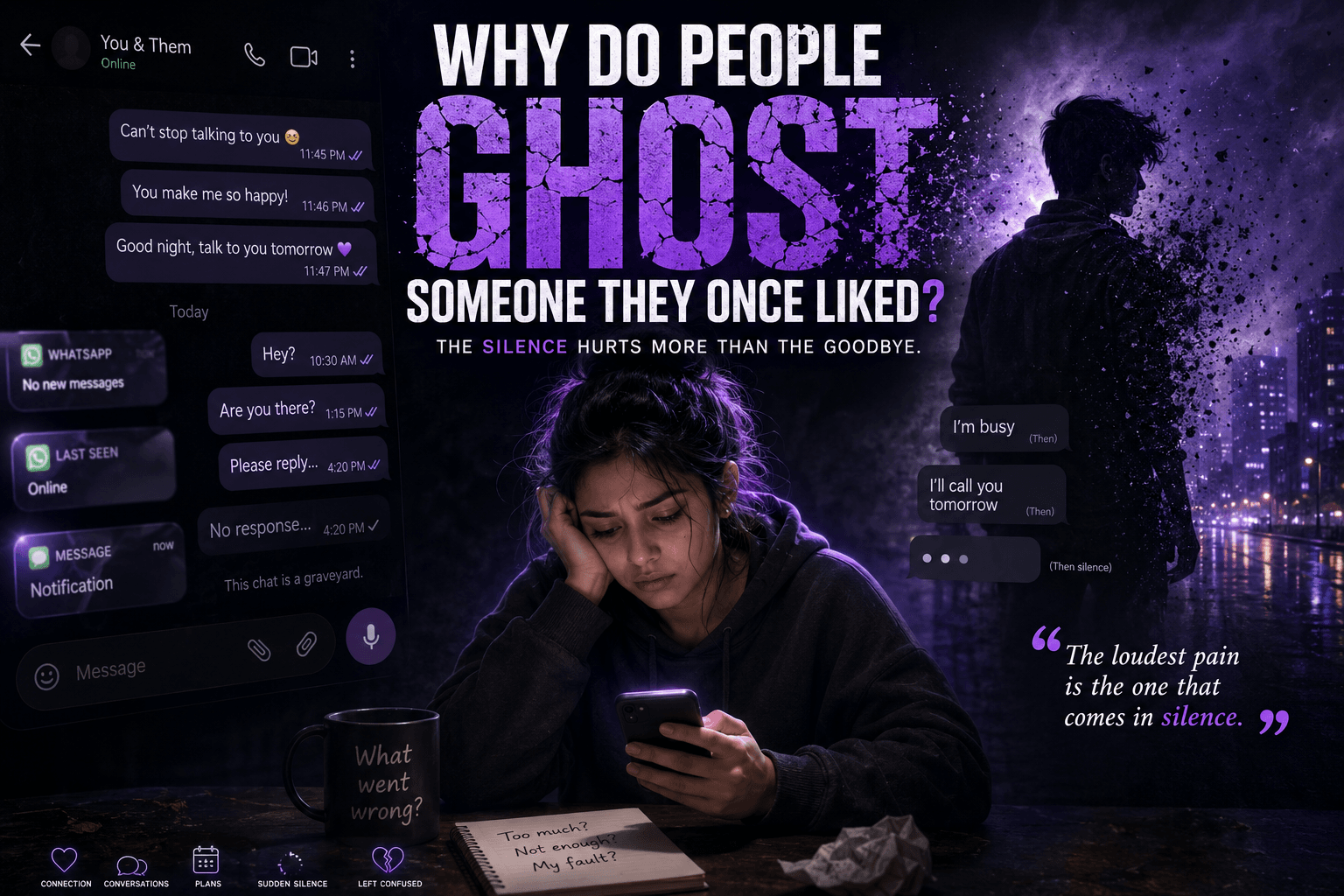
The blue ticks are there. The "Online" status is glowing. But the chat is a graveyard. One week ago, you were sharing song playlists. You were talking about your favorite street food spots. You were planning a weekend movie date. Then, the energy shifted. The replies became shorter. The "haha"s felt forced. Then came the silence. No "I'm busy." No "I don't feel a spark." Just a void where a person used to be. You check your phone every ten minutes. You scroll back through old messages to find the exact moment it went wrong. Was it that one joke? Did I say something too intense? You start rewriting your own history to make sense of their absence. The silence isn't just a lack of words. It is a loud, ringing noise that tells you that you weren't worth an explanation. Why would someone who seemed so into you suddenly treat you like a stranger?
Most people who ghost aren't necessarily villains; they are often people who are terrified of emotional friction. When someone ghosts, they are choosing the path of least resistance. For them, the discomfort of a "breakup" conversation feels like an insurmountable mountain. They imagine the other person crying, getting angry, or asking "why" in a way they cannot answer. To avoid that temporary spike of guilt or awkwardness, they simply vanish. It is a defense mechanism called avoidance. By deleting the conversation or ignoring the notification, they effectively delete the problem from their immediate reality.
Psychologists suggest that this often stems from an insecure attachment style. Some people are "avoidant," meaning when things get too intimate or "real," their internal alarm goes off. The closeness feels like a threat to their independence or a risk of being hurt. Instead of communicating that they feel overwhelmed, they shut down. They don't know how to say, "I like you, but I'm scared of how fast this is moving," so they just stop responding. The ghosting is a shield they use to protect themselves from the vulnerability of being honest.
There is also the "paradox of choice" fueled by modern dating apps. In a world of endless swiping, some people develop a mindset where humans become disposable. They feel that because there are a thousand other options, they don't owe any single person the courtesy of a goodbye. They treat people like profiles rather than humans with feelings. When the initial excitement fades or a small red flag appears, they don't see a reason to work through it. They simply switch to the next "new" feeling. This creates a cycle where the ghoster never learns how to handle conflict, and the ghosted person is left to carry the emotional weight of the unfinished story. It is a failure of emotional maturity, where the fear of a five-minute uncomfortable conversation outweighs the value of another person's peace of mind.
Imagine you are living in Mumbai, navigating the chaos of local trains and high-pressure corporate jobs. You meet someone on a dating app who feels like a breath of fresh air. For three weeks, the chemistry is electric. You spend hours on WhatsApp, sharing the tiny details of your day—the annoying boss, the best cutting chai stall, the dreams you've never told anyone. You feel a genuine connection. Then, after a particularly deep conversation about your childhoods, they disappear. No warning. No "I need space." Just a sudden, cold wall of silence. You spend your commute staring at the screen, feeling a hollow ache in your chest. You start doubting your worth, wondering if you were "too much" or "too boring." The confusion is a heavy weight that makes you overanalyze every single word you sent, turning your mind into a courtroom where you are both the defendant and the judge.
Now, picture a different scenario in a city like Delhi or Indore. You've been seeing someone casually for a few months. You've met their friends, and things seem stable. But as the relationship starts to move toward something more serious, they start pulling away. First, it's "I'm slammed with work." Then, it's "I'll call you tomorrow." Then, the calls stop entirely. You send one last message asking if everything is okay, and that is where the conversation ends. The silence is deafening. In the context of Indian social expectations, where family and social circles often overlap, this kind of ghosting feels even more isolating. You feel a sense of shame, as if the silence is a public statement about your inadequacy. You wonder if they told their friends something about you, or if you simply ceased to exist in their world. The hurt isn't just about the loss of the person; it's about the loss of closure. You are left holding a puzzle with missing pieces, trying to build a picture of what went wrong while the other person has already moved on to a different puzzle. This leaves you in a loop of "what ifs" that can take weeks or months to break, affecting how you trust the next person who enters your life.
The emotional impact is a specific kind of grief called ambiguous loss. Unlike a death or a clear breakup, there is no funeral or final argument to mark the end. You are mourning someone who is still alive and active on social media, perhaps even posting stories of their dinner or a new movie they're watching. Seeing them live their life while you are stuck in the silence creates a feeling of invisibility. It makes you feel as though your emotions were an inconvenience to them. The self-doubt creeps in, and you start believing that you are fundamentally unlovable or that you have some hidden flaw that made them run. This internal narrative is the most damaging part of ghosting; it transforms a reflection of the ghoster's cowardice into a reflection of your own value.
What to do right now Put your phone in another room for two hours. Take a deep breath and acknowledge that the silence you are feeling is not a reflection of your worth, but a reflection of their inability to be honest. Write a letter to them saying everything you are feeling, then burn it or delete the note without sending it. This allows you to release the energy without giving them more power over your emotional state. You are choosing to stop waiting for a permission slip to move on.
Why Do People Ghost Someone They Once Liked? Do People Ghost Someone They Once Liked can improve when you apply one clear step consistently and track progress for at least two weeks.
The blue ticks are there. The "Online" status is glowing. But the chat is a graveyard.
The blue ticks are there. The "Online" status is glowing. But the chat is a graveyard.
Most people who ghost aren't necessarily villains; they are often people who are terrified of emotional friction.
Imagine you are living in Mumbai, navigating the chaos of local trains and high pressure corporate jobs.
Stop the forensic analysis. Scrolling back through old texts to find "the mistake" won't give you the answer because the reason is about their limitations, not your flaws.
Stop the forensic analysis. Scrolling back through old texts to find "the mistake" won't give you the answer because the reason is about their limitations, not your flaws.
Found this helpful? Tap like — it helps us know what readers enjoy.
Share your thoughts. Comments appear after a quick review.
Loading comments…
Reader membership
Want bonus guides and early access? Purchase a Thinkora Reader Pass.
Keep reading
Bookmark this site, explore more in the same lane, or tell a friend who overthinks at 2 AM — that is how good ideas spread without ads.