Why a Growing Number of People Are Trading Smartphones for "Dumb
Editorial Team8 min read
Loading…
A strange thing is happening in a generation that grew up entirely online: a meaningful number of young people are choosing to downgrade. In brief: the shift toward "dumb phones" and digital minimalism is real and growing, and it's backed by legitimate research on attention and wellbeing — but some of the more dramatic claims attached to it, like instant "dopamine resets," go further than the actual evidence supports.
Research tracking the shift found something striking: between 2021 and 2024, 18-to-24-year-olds drove a 148% spike in basic "brick phone" sales, alongside a 12% drop in their own smartphone use — a shift some researchers have described as a deliberate attempt to break the loop of anxiety, comparison, and compulsive checking that smartphone design optimizes for. This isn't a fringe curiosity anymore. It's a measurable behavioral trend with real numbers behind it.
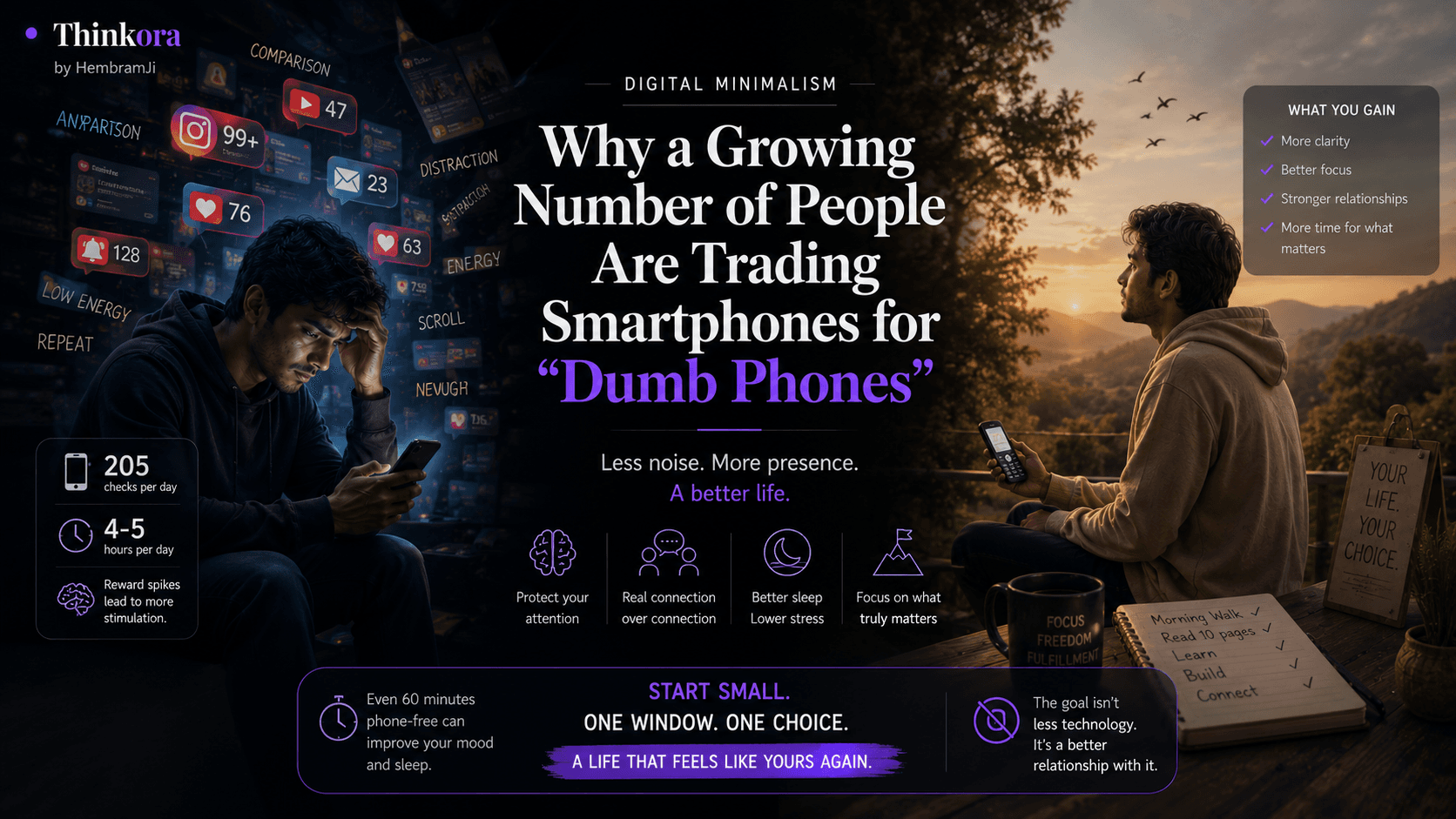
The average person's relationship with their phone has become genuinely intense. Americans check their phones roughly 205 times a day, spending four to five hours on them — more time than a full workday, every single week. That volume of checking isn't accidental. Every notification triggers a small neurological reward response, and when the brain is repeatedly overstimulated this way, those reward spikes become less effective over time, which can drive people to seek out even more stimulation just to feel the same effect.
That's the mechanism researchers point to when they talk about smartphones and compulsive use. It's also where the term "dopamine detox" comes from — though, as we'll get to, that specific phrase oversells what's actually happening in the brain.
Long before "dumb phone" videos went viral, computer science professor Cal Newport coined a more precise term for this approach: digital minimalism. Newport defines it as a philosophy of technology use in which someone focuses their online time on a small number of carefully selected activities that strongly support what they actually value, while happily missing out on everything else. Crucially, this isn't about rejecting technology — it's about being deliberate rather than default about it.
One detail from Newport's framework is worth understanding, because it explains a lot about why constant texting can feel unsatisfying even when it's frequent. Newport draws a distinction between "conversation" — rich, real-time dialogue, whether face-to-face or by voice — and mere "connection," the lower-bandwidth text-based interaction most of our digital lives run on. A like or a quick text exchange can create the feeling of staying close to someone while your actual meaningful relationships quietly go unattended. That gap, more than screen time itself, is often what people are responding to when they say they feel isolated despite being constantly "connected."
Some claims in this space hold up well under scrutiny. Reducing phone use, even modestly, does appear to have a measurable effect on mood and stress. Research indicates that even 60 minutes of phone-free time a day can lower stress and improve sleep quality. Similarly, avoiding devices during specific windows — first thing in the morning, for instance — has shown consistent, if modest, benefits: limiting recreational digital screen use has been shown to increase self-reported overall mental wellbeing and mood, and even short digital sabbaticals of a day or two have been linked to lower stress and greater life satisfaction in multiple studies.
Controlled research on structured interventions backs this up too. One experimental study evaluating a phone-based "digital declutter" app found the intervention meaningfully changed usage patterns, and its authors situated the results within a broader "dose-response" pattern: the impact of smartphone use on wellbeing seems to depend heavily on the amount and nature of that use, and intentional, socially-engaged use tends to counteract problematic patterns, while excessive, undirected use tends to reinforce them.
Here's the honest caveat worth including, because it's where a lot of viral content overreaches. The specific idea that a "dopamine detox" — a weekend, or even a few days, without your phone — dramatically resets your brain chemistry doesn't hold up well against the actual research literature. As one recent, more careful review of the evidence put it directly: claims that a weekend offline resets your brain chemistry are marketing language, not findings drawn from the research — the real, more modest picture from actual studies is less phone use, somewhat better mood, and clearer attention while the boundaries hold.
That same review makes an important, humanizing point: people should expect to break their own digital rules at some point, and the useful response isn't guilt — it's identifying the trigger, adjusting one setting or habit, and continuing. Framing lapses as data to learn from, rather than proof of failure, is itself a more evidence-aligned approach than the all-or-nothing "detox" language often implies.
Findings on digital detox interventions more broadly are genuinely mixed, not uniformly positive. Some studies report clear improvements in wellbeing from digital detox interventions, while others find minimal or inconsistent effects — a reminder that "less phone time" is not automatically the same as "better off," and that the specifics of how someone reduces their use likely matter more than the reduction itself.
You don't need to buy a flip phone to apply what the research actually supports. A few evidence-aligned starting points:
What to do right now Have you tried cutting back on your phone use, or considered a "dumb phone"? We'd love to hear how it's gone for you in the comments.
Pick one specific window today — the first hour after you wake up, or the last hour before bed — and keep your phone out of reach during it. That's a smaller, more evidence-backed starting point than swearing off your smartphone entirely, and it's the kind of change the research actually supports.
If this resonated, you might also like our piece on [INTERNAL LINK: building micro habits that actually stick].
Have you tried cutting back on your phone use, or considered a "dumb phone"? We'd love to hear how it's gone for you in the comments.
Why a Growing Number of People Are Trading Smartphones for "Dumb a Growing Number of People Are Trading Smartphones for "Dumb can improve when you apply one clear step consistently and track progress for at least two weeks.
A strange thing is happening in a generation that grew up entirely online: a meaningful number of young people are choosing to downgrade.
A strange thing is happening in a generation that grew up entirely online: a meaningful number of young people are choosing to downgrade.
Long before "dumb phone" videos went viral, computer science professor Cal Newport coined a more precise term for this approach: digital minimalism.
Some claims in this space hold up well under scrutiny. Reducing phone use, even modestly, does appear to have a measurable effect on mood and stress.
Here's the honest caveat worth including, because it's where a lot of viral content overreaches.
Protect specific windows, not the whole day. Keeping your phone out of the bedroom, or off during the first hour after waking, is a more sustainable and better supported strategy than an all or nothing ban.
Found this helpful? Tap like — it helps us know what readers enjoy.
Share your thoughts. Comments appear after a quick review.
Loading comments…
Reader membership
Want bonus guides and early access? Purchase a Thinkora Reader Pass.
Keep reading
Bookmark this site, explore more in the same lane, or tell a friend who overthinks at 2 AM — that is how good ideas spread without ads.