Why Micro-Habits Are 2026's Biggest Self-Improvement Shift
Editorial Team7 min readUpdated 1 Sep 2026
Loading…
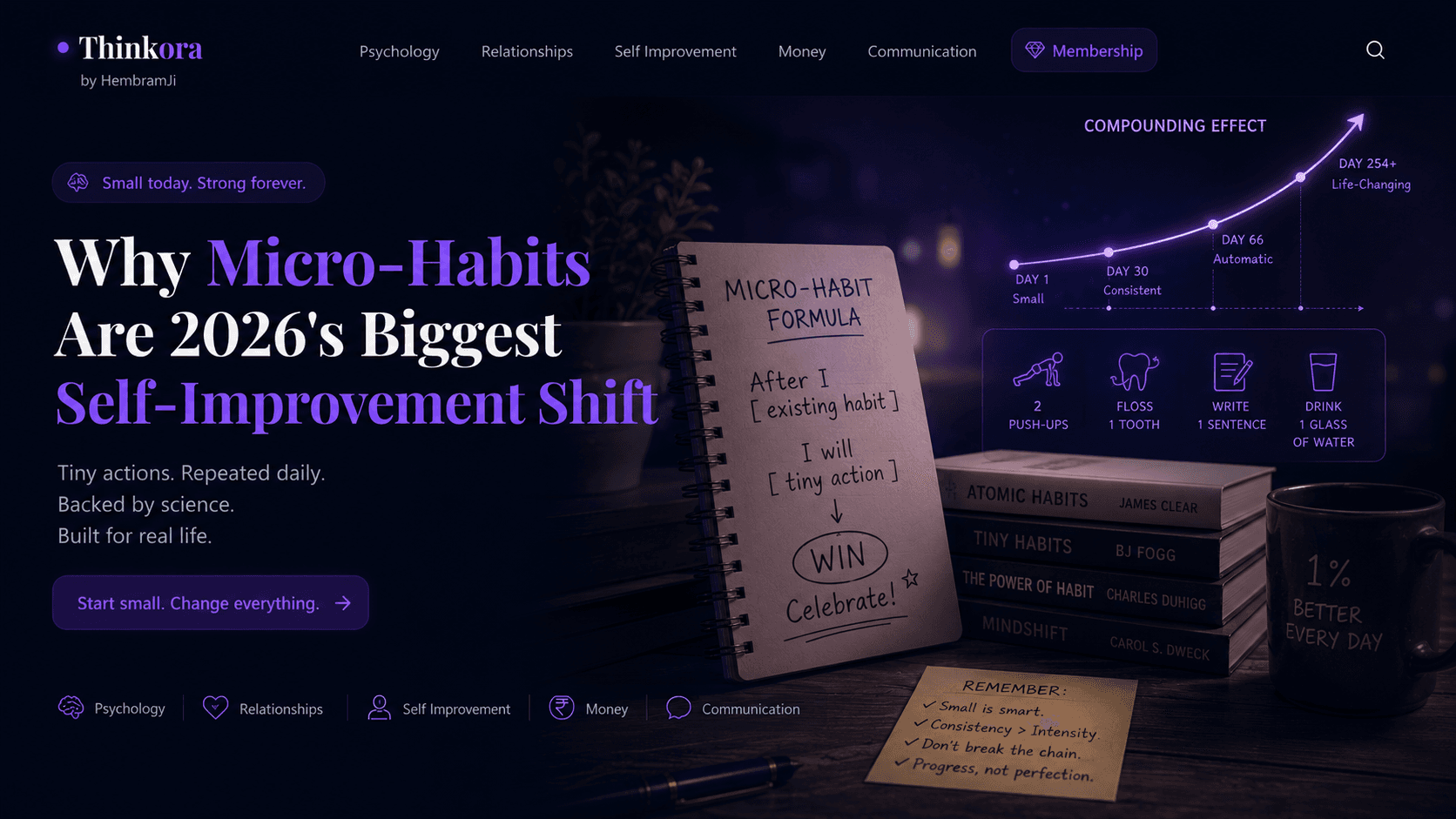
You don't need a 5 a.m. cold plunge, a 12-step morning routine, or a 75-day discipline challenge to change your life. According to current behavioral research, you need something much smaller: one tiny, repeatable action, tied to something you already do.
That idea — often called the micro-habit approach — is quietly replacing the extreme-routine culture that defined self-improvement content for years. It's not a shortcut or a trend built on hype. It's backed by a body of psychology research that's been accumulating for over a decade, and 2026 is the year it's finally reaching the mainstream.
In short: a micro-habit is a behavior so small it's nearly impossible to skip — like doing two push-ups, flossing one tooth, or writing a single sentence — anchored to an existing routine so your brain doesn't have to rely on willpower or motivation to remember it. That's the whole idea. What follows is why it works, how long it actually takes, and how to start one today.
Most people have heard that it takes 21 days to build a habit. That number doesn't come from habit research at all — it traces back to a 1960 observation by a plastic surgeon about how long patients took to psychologically adjust to their new appearance after surgery. It was never a study about behavior change, and the "21 days" figure got separated from its original context as it spread through decades of self-help books.
The real research tells a different story. In 2010, psychologist Phillippa Lally and colleagues at University College London tracked 96 volunteers as they each tried to build one new daily habit — things like eating a piece of fruit at lunch or going for a short run — over 12 weeks. Participants reported daily on whether they'd done the behavior and how automatic it felt.
The time it took participants to reach 95% of their habit's "automaticity" ranged from 18 to 254 days, showing considerable variation in how long habit formation actually takes. On average, that landed around 66 days — roughly ten weeks, not three. Lally herself has since cautioned that this average shouldn't be mistaken for a fixed rule, since the range in her data was so wide.
One more finding matters even more than the headline number: missing a single day of the behavior did not meaningfully disrupt the habit-formation process. The takeaway researchers point to is simple — repeat the behavior daily when you can, but don't panic over the occasional missed day or two. What actually derails habit formation isn't one skipped day — it's the discouragement that follows it, and the tendency to quit altogether after a slip.
If 66-plus days sounds discouraging, the encouraging part is how people successfully get there — and it's rarely through intensity.
Stanford behavior scientist BJ Fogg has spent over two decades studying this exact question at his Behavior Design Lab, working with tens of thousands of participants. His Tiny Habits method holds that a new behavior takes hold when three things line up at once: motivation, ability, and a prompt — and that lasting change comes from breaking goals down into specific, easy actions rather than relying on willpower.
The method has a simple structure: anchor a new tiny behavior to something you already do without thinking — brushing your teeth, pouring your morning coffee, sitting down at your desk — then do something to mark the moment as a small win. Fogg describes this as deliberately causing yourself to feel successful right after the behavior, so you self-reinforce it and make it more likely to become automatic. He's put it even more bluntly in his own research: it isn't repetition alone that wires in a habit — the emotional response you attach to the action plays a defining role in how quickly it sticks.
This is a meaningfully different model than "push through with discipline." It treats habit-building less like a test of character and more like a design problem — one where the size of the first version of the habit matters far less than how reliably it gets triggered.
There's a neurological reason micro-habits tend to survive stressful, busy periods better than ambitious routines do — and it connects to how the brain handles pressure more broadly.
Habitual behavior and deliberate, goal-directed behavior rely on different mental resources. Habits allow for automatic responses in familiar contexts and can help people act appropriately even when their cognitive capacity is limited, such as during acute or chronic stress. Cognitive flexibility — the mental ability to shift strategies and make deliberate decisions — is a more resource-intensive process, and research shows this kind of top-down, deliberate thinking is particularly vulnerable to the effects of stress.
In practice, this explains a familiar pattern: an ambitious new routine that requires planning and decision-making tends to collapse during a stressful week, while a habit small enough to run on autopilot — because it's already wired to a existing cue — is far more likely to survive. This is exactly the mechanism the 2026 shift away from elaborate morning routines seems to be responding to: not laziness, but a more realistic read of how the brain actually operates under modern-day cognitive load.
Putting the research together, a workable starting point looks like this:
[INTERNAL LINK: how to set realistic goals without burning out]
What to do right now You don't need to plan a new life this week. Pick one existing routine you already do without fail, attach one absurdly small action to it, and notice — however briefly — when you've done it. That's the entire system. If
You don't need to plan a new life this week. Pick one existing routine you already do without fail, attach one absurdly small action to it, and notice — however briefly — when you've done it. That's the entire system. If you try it, it's worth checking back in on it in about ten weeks, not ten days, before deciding whether it's working.
Why Micro Habits Are 2026's Biggest Self Improvement Shift Micro-Habits Are 2026's Biggest Self-Improvement Shift can improve when you apply one clear step consistently and track progress for at least two weeks.
You don't need a 5 a.m. cold plunge, a 12 step morning routine, or a 75 day discipline challenge to change your life.
You don't need a 5 a.m. cold plunge, a 12 step morning routine, or a 75 day discipline challenge to change your life.
If 66 plus days sounds discouraging, the encouraging part is how people successfully get there — and it's rarely through intensity.
Putting the research together, a workable starting point looks like this: Pick one behavior, not five.
If 66 plus days sounds discouraging, the encouraging part is how people successfully get there — and it's rarely through intensity.
Found this helpful? Tap like — it helps us know what readers enjoy.
Share your thoughts. Comments appear after a quick review.
Loading comments…
Reader membership
Want bonus guides and early access? Purchase a Thinkora Reader Pass.
Keep reading
Bookmark this site, explore more in the same lane, or tell a friend who overthinks at 2 AM — that is how good ideas spread without ads.