What "Golden Retriever Boyfriend" Really Means
Editorial Team8 min readUpdated 25 Aug 2026
Loading…
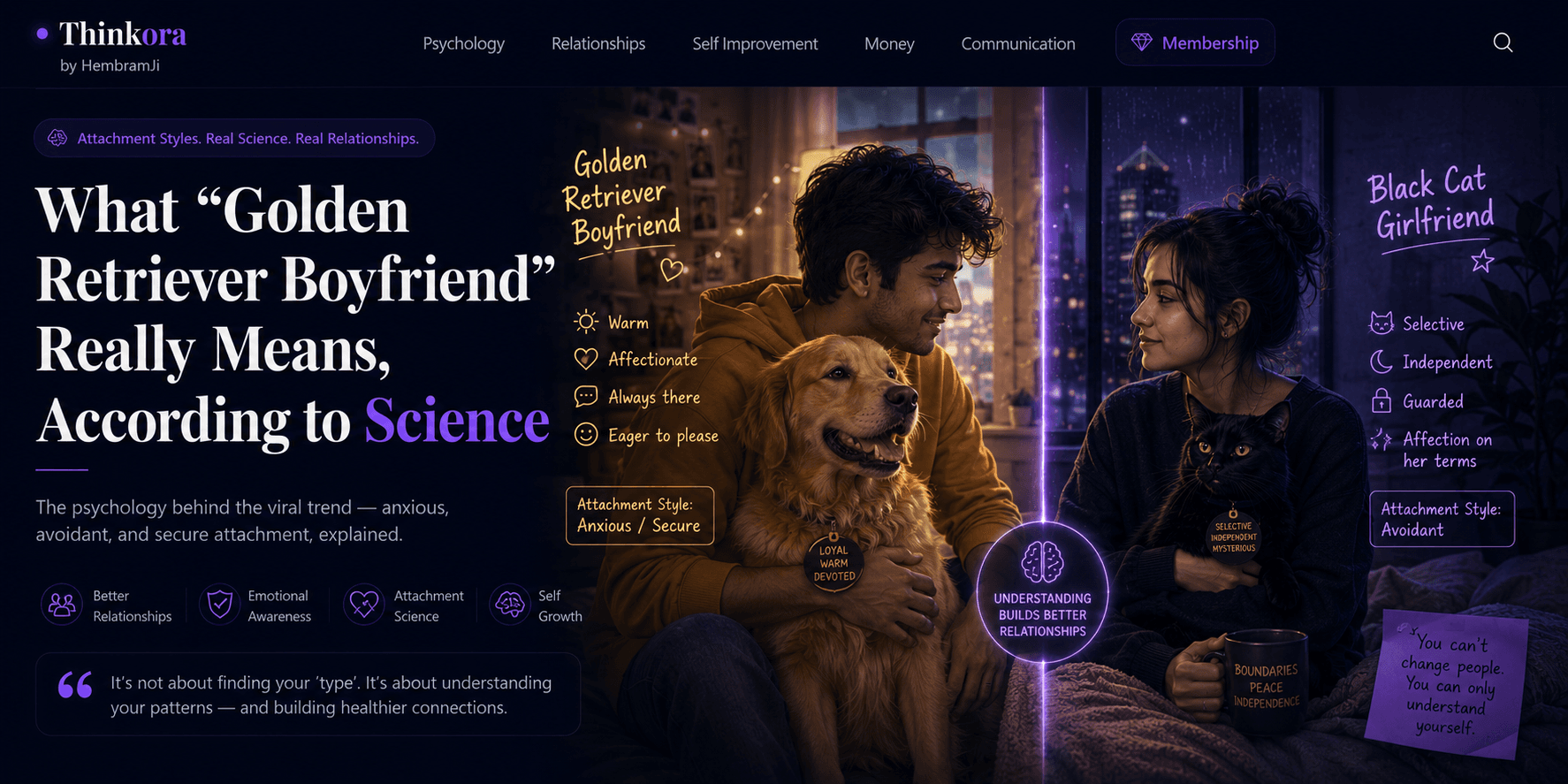
If you've spent any time on TikTok lately, you've probably seen someone describe their partner as a "golden retriever boyfriend" — warm, eager, affectionate, always the first to text back. Maybe you've also seen his counterpart: the "black cat girlfriend," cool, selective, hard to pin down. In brief: this isn't just a cute internet meme. Relationship therapists say the trend maps almost perfectly onto a well-studied psychological framework called attachment theory — and understanding it can tell you a lot more about your relationships than a dog-breed comparison ever could.
The golden retriever archetype describes a partner who is devoted, outgoing, affectionate, and always ready to have fun, according to Liza Gold, LCSW, founder and director of Gold Therapy NYC. His opposite, the black cat, is introverted, selective, guarded, and self-possessed — someone who offers affection on her own terms rather than chasing it, as writer and therapist Israa Nasir describes it. The pairing has become a full-blown cultural shorthand, with couples like Zendaya and Tom Holland frequently cited online as the real-life version of the dynamic.
Here's where it gets genuinely useful. Gold, the therapist, has been direct about the connection: she links golden retriever boyfriends and black cat girlfriends to anxious attachment and avoidant attachment styles respectively, noting these relationships usually work with a fairly high degree of conflict, because the two partners have opposing needs.
That framework — anxious, avoidant, and secure attachment — comes from decades of developmental psychology, not social media. It's rooted in the work of psychiatrist John Bowlby and developmental psychologist Mary Ainsworth, whose research on how infants bond with caregivers was later extended into adult romantic relationships. The most widely read popular explanation of this research is the book Attached, by psychiatrist Dr. Amir Levine and psychologist Rachel Heller, which describes three attachment styles: secure (just over half of people), who are comfortable with intimacy; anxious (roughly 20%), who crave closeness but fear rejection; and avoidant (roughly 25%), who see intimacy as a threat to their independence.
Sound familiar? It should. The "golden retriever" — warm, eager to close distance, always initiating — lines up closely with anxious attachment tendencies at their most affectionate. The "black cat" — cool, self-contained, withholding until she's ready — echoes classic avoidant patterns. As Nasir puts it, the golden retriever, at their best, isn't actually anxious — they're simply secure, though the internet has decided to treat consistent affection as either adorable or slightly threatening depending on the day.
If you've ever found yourself powerfully drawn to someone who runs hot-and-cold, there's a name for that too: the anxious-avoidant trap. Levine and Heller describe it as a dynamic where partners have opposing intimacy needs, and small disagreements actually mask a deeper conflict about how much closeness each person wants. The result is a predictable cycle: the anxious partner's attempts to get closer trigger the avoidant partner's instinct to create distance, producing a rollercoaster of intense closeness followed by withdrawal.
This isn't a minor quirk — it's one of the more consistent, replicated patterns in relationship psychology. One therapist who works with this dynamic clinically describes it as genuinely compelling precisely because the chemistry doesn't respond to willpower alone; Levine and Heller documented how these complementary attachment styles can create the illusion of deep connection while actually generating chronic relational distress.
There's a popular idea that opposites attract — that the anxious-avoidant spark is proof of real chemistry. The research doesn't really back that up. As Gold puts it plainly: there's a substantial body of research showing that opposites don't actually attract — people with similar interests and similar personality traits tend to be drawn to each other instead. The anxious-avoidant pull isn't chemistry finding its match. It's often two nervous systems responding to each other's unmet needs.
Social media tends to frame the golden retriever as an unambiguous prize — finally, a partner who shows up. But therapists are flagging real caveats. Relationship coach Greta Bereisaite has pointed to people-pleasing, co-dependency, and disregard for personal boundaries as red flags that can hide inside "golden retriever" behavior, noting it can feel loving and cute at first but grow overwhelming over time. And Gold adds a practical question worth asking yourself: what happens in the moments when you're not in the mood to be upbeat or affectionate — does that version of the relationship still work?
There's also an important piece of good news buried in the research that the trend rarely mentions: attachment styles aren't a life sentence. Decades of subsequent research show attachment patterns, while rooted in early experience, can shift over time through significant relationships and through conscious effort. And when it comes to who actually functions best long-term, the data has a clear answer: couples where both partners are securely attached tend to be happier and function better than couples where both are anxious or avoidant — though somewhat surprisingly, "mixed" couples with one secure partner tend to function nearly as well.
You don't need a psychology degree to use this. A few honest questions can tell you more than any TikTok archetype:
None of this means you need to abandon a relationship because your partner is more avoidant or more anxious than you are. It means paying attention to the pattern, naming it honestly, and — if it's the rollercoaster kind of pull rather than the steady kind — treating that as useful information rather than proof of true love.
What to do right now Before you swipe past the next "golden retriever vs. black cat" video, try turning the question inward instead of outward: not "which one is my partner," but "which one am I, and does that pattern serve me?" That's a much more useful place to start than any dog-breed comparison.
Before you swipe past the next "golden retriever vs. black cat" video, try turning the question inward instead of outward: not "which one is my partner," but "which one am I, and does that pattern serve me?" That's a much more useful place to start than any dog-breed comparison.
If you're curious how this connects to the patterns you keep repeating in relationships, you might also enjoy our piece on [INTERNAL LINK: how to recognize your own attachment style].
Have you noticed the golden retriever/black cat dynamic in your own dating life? We'd love to hear about it in the comments.
What "Golden Retriever Boyfriend" Really Means "Golden Retriever Boyfriend" Really Means can improve when you apply one clear step consistently and track progress for at least two weeks.
If you've spent any time on TikTok lately, you've probably seen someone describe their partner as a "golden retriever boyfriend" — warm, eager, affectionate, always the first to text back.
If you've spent any time on TikTok lately, you've probably seen someone describe their partner as a "golden retriever boyfriend" — warm, eager, affectionate, always the first to text back.
If you've ever found yourself powerfully drawn to someone who runs hot and cold, there's a name for that too: the anxious avoidant trap.
Social media tends to frame the golden retriever as an unambiguous prize — finally, a partner who shows up.
You don't need a psychology degree to use this. A few honest questions can tell you more than any TikTok archetype: Am I drawn to consistency, or to the high of someone finally showing up after pulling away?
Am I drawn to consistency, or to the high of someone finally showing up after pulling away?
Found this helpful? Tap like — it helps us know what readers enjoy.
Share your thoughts. Comments appear after a quick review.
Loading comments…
Reader membership
Want bonus guides and early access? Purchase a Thinkora Reader Pass.
Keep reading
Bookmark this site, explore more in the same lane, or tell a friend who overthinks at 2 AM — that is how good ideas spread without ads.