What AI Texts Are Doing to Real Communication
Editorial Team10 min readUpdated 1 Aug 2026
Loading…
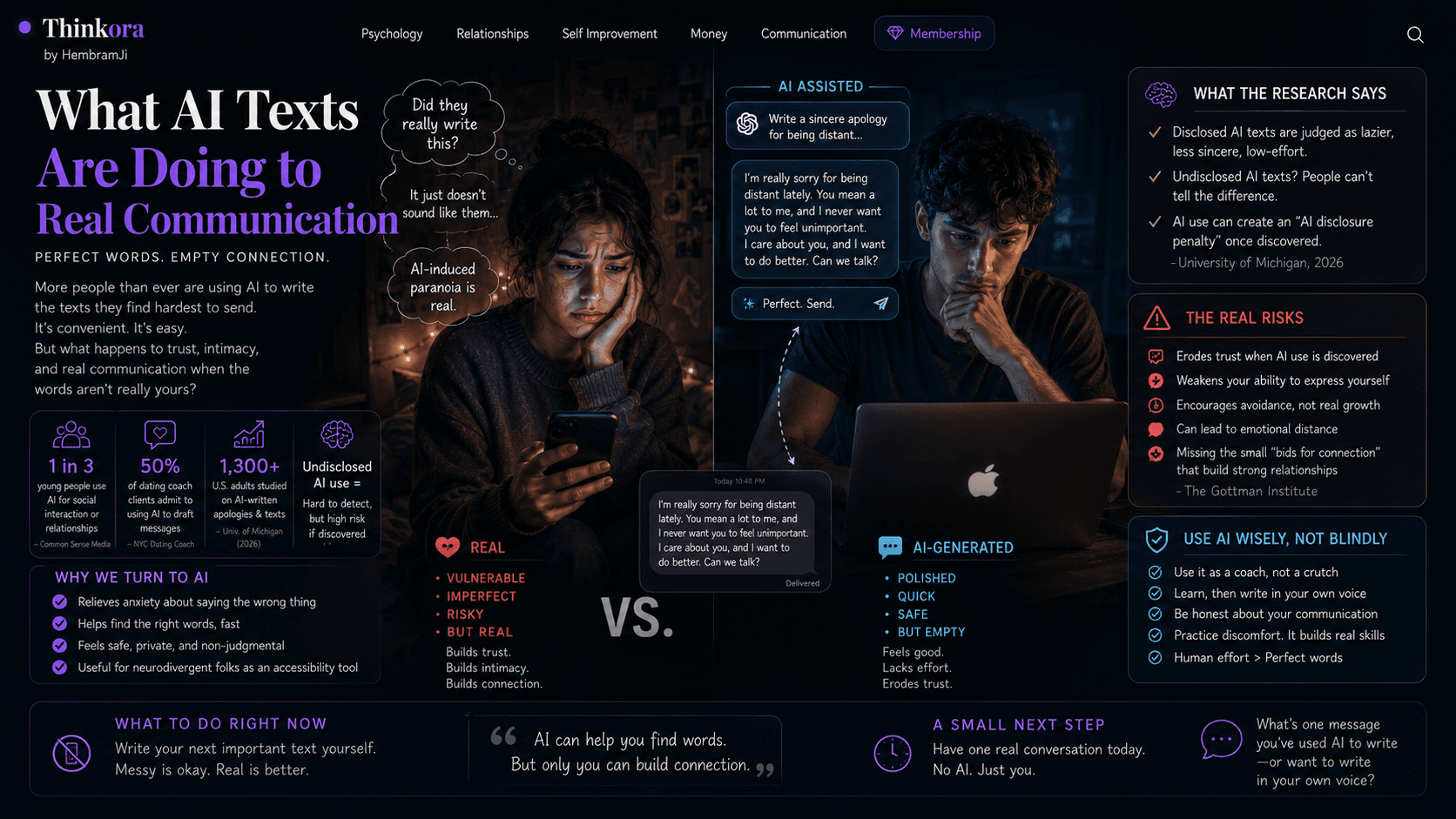
You get a ping from your partner that reads like a carefully crafted haiku—each line lands with the right rhythm, the tone is warm yet precise, and a fleeting thought slips in: Did they actually type this? That whisper of doubt has become a background hum in many Indian chats, especially among college crowds in Delhi and Hyderabad who joke about “AI‑induced paranoia” in Discord servers and WhatsApp groups. A 2024 Common Sense Media snapshot showed that roughly one in three young Indians between 18 and 24 have turned to a chatbot for help polishing a social exchange—whether it’s drafting an apology after a missed birthday, smoothing a disagreement over rent with a roommate in Bangalore, or even writing a flirtatious opener for a first date on a dating app. The habit isn’t confined to campuses; a Mumbai‑based relationship coach notes that about half of her clientele, ranging from early‑career professionals to newlyweds, admit to using ChatGPT or similar tools to shape messages to their partners.
This shift reflects more than a novelty gadget; it reveals what happens to the emotional muscle of conversation when we start outsourcing its most tender, awkward bits—apologies, boundaries, hard truths—to an algorithm. Crafting something sincere and uncomfortable has always demanded a sliver of courage. Generative AI offers a shortcut: feed it a prompt, receive a flawless paragraph in seconds, and the anxiety of stumbling over words seems to evaporate. For anyone who feels tongue‑tied or worries about saying the wrong thing, that can feel like genuine relief.
Dr. Shawntres Parks, a sex and couples therapist who works with neurodivergent clients in Bengaluru, highlights that AI can serve as a helpful accessibility aid. When someone struggles to pick up subtle social cues in real time, a quick AI‑generated draft can illuminate phrasing patterns they might otherwise miss, acting like a set of training wheels. The risk appears when those wheels never come off, and the tool becomes a permanent stand‑in for the skill itself, leaving the user reliant on an external voice for even the most basic exchanges.
In 2026, psychologists Andras Molnar of the University of Michigan and Jiaqi Zhu conducted a study with over 1,300 participants ranging from 18 to 84 years old. They wanted to know how learning that a message was AI‑generated changes the way we judge its sender. Participants read identical notes—apologies, thank‑you messages, casual check‑ins—sometimes told the text was written by a person, sometimes told it came from a chatbot, and sometimes given no information at all.
When the source was disclosed as AI, raters judged the sender as lazy, insincere, and low‑effort. The very same wording, when believed to be human‑authored, was seen as genuine, grateful, and thoughtful. Interestingly, participants who weren’t told anything about the author couldn’t reliably distinguish AI‑written from human‑written text; their impressions were almost identical. This creates an asymmetry: undisclosed AI use flies under the radar, but once the truth surfaces, it triggers a social penalty.
The researchers link this pattern to the “effort heuristic”—our tendency to value something more when we believe real work went into it. A handwritten note feels weightier than a printed copy, not because the ink is superior, but because the act of writing by hand signals effort. When a message is spit out in seconds, even if the language is flawless, the perceived effort drops, and with it, part of the message’s emotional resonance—provided the receiver knows the origin. In Indian contexts, where handwritten letters still carry sentimental weight during festivals like Raksha Bandhan or Diwali, the heuristic feels especially potent: a AI‑generated Diwali greeting may read beautifully, but if the recipient learns it was machine‑made, the gesture can feel hollow.
Beyond the question of authenticity lies a deeper purpose for conversation. The Gottman Institute, whose decades of research have mapped the habits that keep relationships strong, draws a clear line between what AI can help with and what it fundamentally cannot replicate. AI is handy for expanding your emotional vocabulary, summarizing relationship studies, or rehearsing a tough talk before you have it. Where it falls short, according to Gottman’s team, is in recognizing a “bid for connection”—those fleeting, real‑time signals (a sigh, a glance, a hand reaching across a table) that partners either turn toward or away from. Those micro‑moments are among the strongest predictors of long‑term relationship stability.
A chatbot can describe a bid for connection in textbook language, but it cannot notice one happening because it lacks a body, a room, and the immediacy of real‑time feedback. True communication skill isn’t just about stringing together the right words; it’s built through repeated practice of saying something imperfect, watching the other person’s reaction, and adjusting on the spot, with real stakes. Dr. Robb, a psychologist featured in RELEVANT magazine, emphasizes that genuine relationships require a degree of discomfort—it’s how we learn to express feelings, risk rejection, and navigate conflict. If AI continually absorbs that discomfort, the underlying skill never gets the repetitions it needs to mature.
Consider a young professional in Jaipur who uses AI to draft a difficult conversation with her manager about workload. She reads the bot’s polite script, senses the lack of her own urgency, and rewrites it in her own voice, adding a specific example of a recent project that overwhelmed her. The manager appreciates the clarity and the personal touch, and she has practiced asserting her needs—an exchange that would have been missed if she had simply copied the AI output.
There’s also a more immediate, practical danger: getting caught. Multiple therapists recount a familiar scene: a partner receives a message that feels unusually polished, the phrasing doesn’t match the sender’s usual voice, and a seed of doubt is planted. When the suspicion is confirmed—often after a casual “Did you use AI?”—the reaction tends to feel like a small betrayal. It’s not that the words were wrong; it’s that the gesture signals an unwillingness to show up authentically in a vulnerable moment.
A communication strategist quoted by AZ Big Media offered a useful reframing: the aim isn’t to ban AI from personal chats, but to use it to clarify your own thoughts rather than replace your voice. Before hitting send on an AI‑assisted note, ask yourself: Does this actually sound like something I would say? Am I using the tool to be more honest, or to sidestep discomfort? Would I feel embarrassed if the other person knew AI helped write the message? Those questions act as an honesty filter, keeping the technology in a supportive role rather than letting it become a crutch.
In a recent case from Pune, a college student noticed her boyfriend’s texts had started sounding unusually formal, replete with idioms she’d never heard him use. When she gently asked, he admitted he’d been using a chatbot to “sound more mature.” The revelation sparked a conversation about authenticity, and they agreed to limit AI use to brainstorming only, preserving the rawness that made their early chats feel special.
None of this means AI has no place in how we communicate. Used thoughtfully, it can assist with tasks that were always somewhat mechanical—untangling a confusing paragraph, organizing scattered thoughts before a difficult conversation, or building emotional vocabulary for people who never got much practice naming their feelings. The recurring distinction in the research is between AI as preparation and AI as substitution. Using the tool to think through what you want to say, then setting it aside and writing the actual message yourself, preserves the essential human element. Letting it generate the final message wholesale, especially for anything emotionally significant, is where the research suggests real costs begin to appear—both in how the message lands and in the communication skills that never get exercised.
Consider the example of a college student in Pune who needs to tell her roommate she’s moving out. She feeds the situation into a chatbot, gets a courteous draft, reads it, notices a few phrases that feel too formal, rewrites them in her own voice, and sends the revised note. The roommate appreciates the honesty, and the student has practiced the delicate balance of clarity and kindness. In contrast, if she had simply copied the AI output and sent it unchanged, the roommate might have sensed a lack of personal investment, and the student would have missed the chance to stretch her own communicative muscles.
Another illustration comes from a group of engineering undergraduates in Chennai preparing a joint apology to a professor after a lab mishap. They used AI to generate a skeleton apology, then each member added a personal sentence reflecting their own role and feelings. The professor responded positively, noting the sincerity of the individual touches, and the students reported feeling more confident in future difficult conversations because they had practiced blending structure with personal voice.
If you’ve leaned on AI for a message that mattered—an apology, a check‑in, a hard conversation—pause before you reach for it again and ask: Am I trying to say something more clearly, or am I trying to avoid the discomfort of saying it at all? Both impulses are understandable. Only the first one builds the skill you’ll need the next time a tough moment arrives. [INTERNAL LINK: active listening and the Gottman “bids for connection” concept]
What’s your take—have you ever suspected a message you received wasn’t fully human‑written? We’d genuinely like to hear about it in the comments.
What to do right now What's your take — have you ever suspected a message you received wasn't fully human-written? We'd genuinely like to hear about it in the comments.
What AI Texts Are Doing to Real Communication AI Texts Are Doing to Real Communication can improve when you apply one clear step consistently and track progress for at least two weeks.
You get a ping from your partner that reads like a carefully crafted haiku—each line lands with the right rhythm, the tone is warm yet precise, and a fleeting thought slips in: Did they actually type this?
You get a ping from your partner that reads like a carefully crafted haiku—each line lands with the right rhythm, the tone is warm yet precise, and a fleeting thought slips in: Did they actually type this?
In 2026, psychologists Andras Molnar of the University of Michigan and Jiaqi Zhu conducted a study with over 1,300 participants ranging from 18 to 84 years old.
Beyond the question of authenticity lies a deeper purpose for conversation. The Gottman Institute, whose decades of research have mapped the habits that keep relationships strong, draws a clear line between what AI can help with and what it fundamentally cannot replicate.
There’s also a more immediate, practical danger: getting caught. Multiple therapists recount a familiar scene: a partner receives a message that feels unusually polished, the phrasing doesn’t match the sender’s usual voice, and a seed of doubt is planted.
Use AI to brainstorm or outline, then write the final message in your own voice.
Found this helpful? Tap like — it helps us know what readers enjoy.
Share your thoughts. Comments appear after a quick review.
Loading comments…
Reader membership
Want bonus guides and early access? Purchase a Thinkora Reader Pass.
Keep reading
Bookmark this site, explore more in the same lane, or tell a friend who overthinks at 2 AM — that is how good ideas spread without ads.